
To promote your business on LinkedIn in Ghana, decide exactly who you want to reach. Then fix your profile and company page so they explain what you sell, post useful work on a steady schedule, take part where your buyers talk, and give every visitor one clear next step: a call, a WhatsApp chat or your website.
LinkedIn is not the biggest network in Ghana, but it is the one where decision-makers say who they are and what they do. In early 2025, LinkedIn’s own advertising tools counted 3.00 million members in Ghana, about 14.8% of adults (DataReportal, Digital 2025: Ghana). That figure counts registered members, not daily users, so treat it as the ceiling of your audience, not the crowd you will meet. For a business selling to other businesses, such as a logistics firm, a school supplier, an accounting practice or a software studio like ours, that is still the right room to be in. Here are five ways to use it without wasting your evenings.
1. Know exactly who you want to reach
Most LinkedIn effort fails before the first post because the target is “everyone in business”. Write down, in one sentence, the person who signs the cheque for what you sell. For example: “operations managers at haulage companies in Tema and Kumasi” or “owners of private basic schools in Greater Accra”.
That sentence decides everything else:
- Who you connect with. Send requests to people who match it, or who work closely with them, and add a one-line note saying why. A smaller network of the right people beats a large one of strangers.
- What you post. Write about the problems that person has this month, not about your company’s anniversary.
- Where you comment. Follow the companies and people they follow.
If you sell to more than one type of buyer, pick the most valuable one for the next 90 days. You can widen the net later.
2. Make your profile and company page do the selling
 When someone sees your comment or post, they click your name. What they find in the next ten seconds decides whether they get in touch.
Your personal profile:
- Headline: say who you help and how, not just your job title. “I help Ghana schools collect fees by MoMo and cut admin” tells a visitor far more than “CEO”.
- Photo and banner: a clear, recent photo, and a banner that shows your work or your city, not a stock image of a handshake.
- About section: three short paragraphs covering who you serve, the results you deliver, and how to reach you. Include your WhatsApp business number and your website.
- Featured section: pin a case study, a price guide or a short video, not your oldest post.
Your company page:
- Fill in every field: industry, size, location and website. Upload a logo that is readable when small.
- Write the description for a buyer, not for an investor.
- Ask your team to list the company correctly as their employer, so their activity links back to the page.
The page is free, so there is no reason to leave it half done. A buyer who finds an empty page will assume an empty business.
3. Post useful work, on a schedule you can keep
You do not need to post every day. You do need to post often enough that people remember you. Once or twice a week, every week, beats a burst of ten posts followed by two months of silence.
What works for Ghanaian B2B firms:
- Show the work. A before-and-after of a process you improved, a photo from a site visit, or a short screen recording of something you built, with the client’s permission and with names removed.
- Answer real questions. Every question a prospect asked you this month is a post. “How long does it take to set up MoMo payments on a website?” is more useful than “We are passionate about excellence”.
- Share numbers you can stand behind. If you mention a statistic, link the source in the post or in the first comment.
- Write like you talk. Short paragraphs, plain English, one idea per post.
Keep a simple list of post ideas in your phone. When a client asks a good question, write it down.
4. Join the conversation where your buyers already are
 Your posts reach people who already follow you. Comments reach everyone else. Spend more time commenting than posting, especially when you are starting out.
- Comment with substance. Add a fact, an example or a question. “Great post!” does nothing for anyone.
- Use groups carefully. LinkedIn groups for Ghanaian industries, alumni networks and professional bodies can be useful, but many are full of spam. Join a few active ones, read before you post, and never drop a sales link as your first contribution.
- Turn up offline too. Events in Accra and Kumasi, such as chamber of commerce meetings, industry forums and tech meetups, are where LinkedIn connections become real relationships. Connect with people within a day of meeting them, and mention where you met.
5. Give every visitor a clear next step
Attention is only useful if it turns into a conversation. Decide what you want a prospect to do after they read your post or profile, and make that step easy.
- One main call to action. For most Ghanaian SMEs, a WhatsApp chat is the lowest-friction first step. Put a click-to-chat link on your profile and website. WhatsApp’s own click to chat feature opens a chat with a message already written.
- A website that finishes the job. Your profile should link to a page that loads quickly on an Android phone, explains your offer and shows prices or a starting point. If yours does not, read our guide to website design that converts in Ghana.
- Make it easy to pay. When a lead is ready to buy, send a clear invoice they can settle by MTN MoMo, Telecel Cash or bank transfer.
Paid options: when to use them
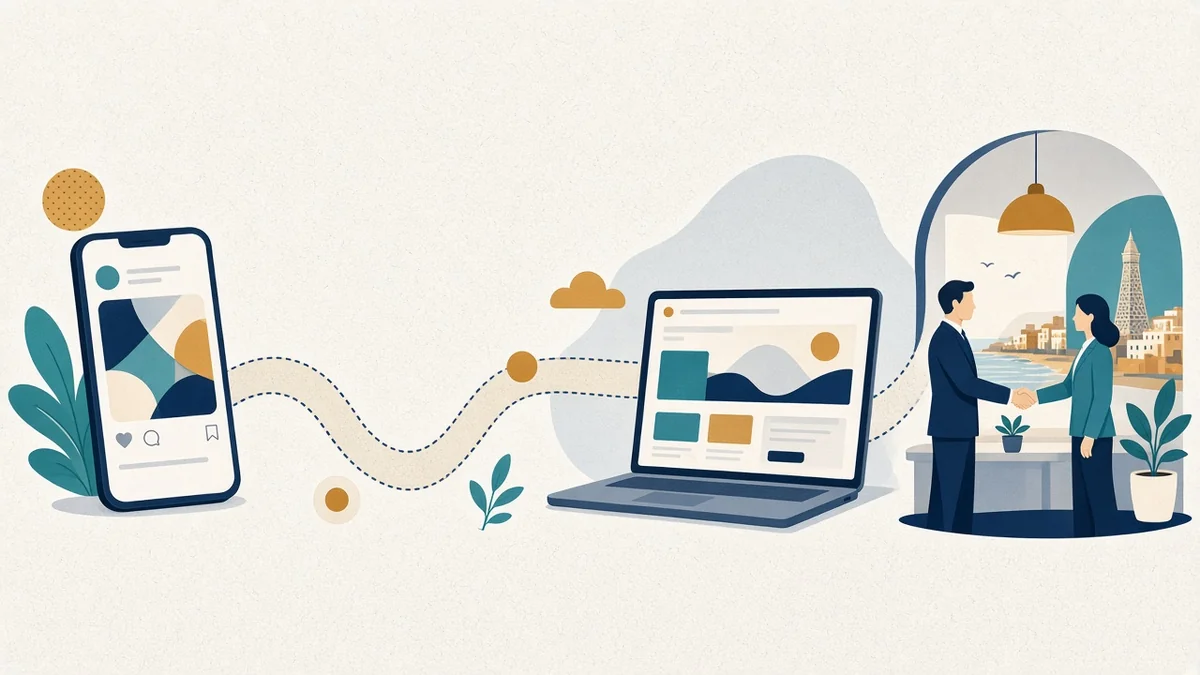
LinkedIn ads let you target by job title, industry and company size. That precision costs more per click than most other platforms. For most Ghanaian SMEs, the order is: complete profile, then steady posting, then a small, tightly targeted test campaign aimed at one offer with one landing page. Measure enquiries, not likes. If you cannot track which leads came from the campaign, do not scale it.
A simple weekly routine
- Monday (15 minutes): reply to messages and accept or decline connection requests.
- Tuesday (30 minutes): publish one post from your ideas list.
- Wednesday to Friday (10 minutes a day): leave three useful comments on posts by people in your target list.
- Friday (10 minutes): note any enquiries and where they came from.
That is about 90 minutes a week. Done for three months, it builds more than a burst of activity ever will.
How PED Solution Studios can help
We build the part LinkedIn sends people to: a fast website with WhatsApp chat built in, SEO, social media links and MoMo-ready payment options. Our GH₵4,499 website package includes WhatsApp chat integration, SEO, social media links, and a free domain and hosting for the first year. See our website services or our digital marketing services.
Frequently asked questions
Is LinkedIn worth it for a small business in Ghana?
Yes, if you sell to other businesses or professionals. LinkedIn had about 3.00 million registered members in Ghana in early 2025 (DataReportal). If you sell mainly to consumers, Facebook, Instagram, TikTok and WhatsApp usually reach more of your buyers.
Should I post from my personal profile or the company page?
Both, but personal profiles usually get more reach because people follow people. Post from your own profile, and share the most useful posts on the company page too.
How often should I post on LinkedIn?
Once or twice a week is enough if you keep it up. Consistency matters more than volume.
Should I connect with everyone who sends a request?
No. Accept people who match your target buyer, work in your industry, or whom you have met. A focused network makes your feed and your reach more useful.
Do LinkedIn ads work in Ghana?
They can for high-value B2B offers, but they are expensive per click. Start with a small test aimed at one clear offer and track enquiries, not impressions.
Get your LinkedIn traffic somewhere useful
If your profile is ready but your website is not, book a call with us or send us a message. We will tell you what to fix first.