
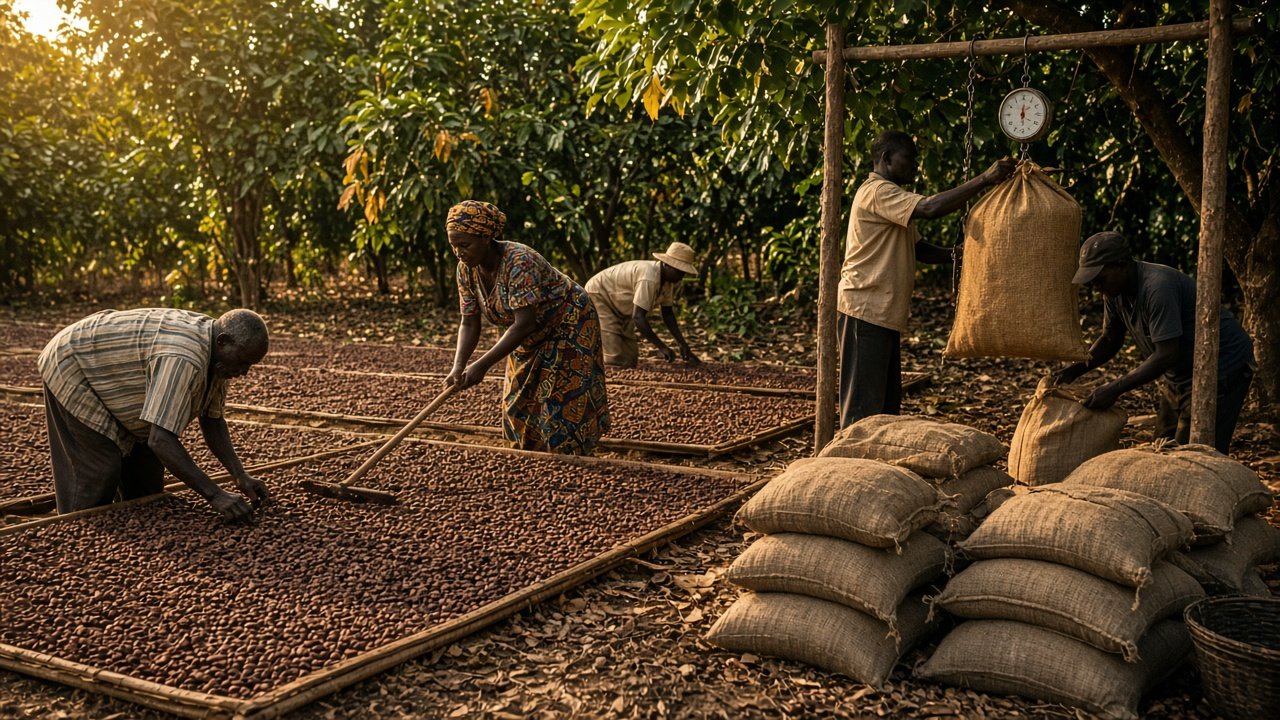
Agribusiness software in Ghana connects the field to the warehouse and the buyer. It registers farmers and their plots, records inputs given on credit, weighs and grades produce at collection, pays farmers by mobile money, tracks stock, and keeps the traceability records export buyers ask for. It must also work offline, because most collection points have weak or no signal.
This guide is for aggregators, outgrower schemes, input dealers, processors and exporters across Ghana, from the Ashanti and Bono cocoa belts to grain and poultry businesses in the north and around Kumasi. It explains what the software has to do, what products exist, and when a custom system is worth building. PED Solution Studios builds custom software and operations software in Accra and takes agribusiness work. We have no published agriculture project yet, so this guide makes no claims about agricultural results.
Who needs agribusiness software
- Aggregators and licensed buyers who collect from many farmers and need a clean record of who supplied what, when and at what grade.
- Outgrower schemes that give seed, fertiliser or chemicals on credit and recover the cost at harvest.
- Input dealers with stock in several towns.
- Processors (cocoa, cashew, shea, grains, poultry feed) who need to trace a batch back to its source.
- Exporters whose buyers ask for farm-level traceability.
If you are a single farm keeping your own books, a farm-record app or a spreadsheet may be enough. The case for software grows with the number of farmers, sites and buyers.
What the software has to do
Farmer and plot registry. Name, ID, phone number (for mobile money), community, group or cooperative, crops, and the location and size of each plot.
Inputs on credit. What each farmer received, at what value, and what they still owe, so the deduction at harvest is fair and visible to the farmer.
Collection and grading. Weights, moisture or quality grade, price per unit and the collection point, all recorded at the scale, not copied from a notebook a week later.
Payments. Paying hundreds of farmers by MTN MoMo, Telecel Cash or AT Money, net of any input credit, with a receipt each farmer can see.
Warehouse and stock. Stock by warehouse, bag or lot, transfers between depots, losses, and what has been sold or shipped.
Reporting. Volumes by community and season, credit outstanding, and traceability reports for buyers.
Offline field apps for collection points
Signal at a buying centre in the Western North, or at a cooperative in the Upper East, cannot be assumed. A field app for agribusiness should:
- Work fully offline and sync when signal returns, without creating duplicate records.
- Capture GPS points or plot boundaries, and photos, on a mid-range Android phone.
- Read from a scale or let the clerk enter weights quickly, with checks against typos.
- Show the field officer only what they need for the day.
PED builds for web and Android first. BYOB, a commerce and logistics platform we built, for example, runs three React Native apps for iOS and Android (BYOB Sales, BYOB Rider and BYOB Warehouse) on one shared record. It is not agricultural, but the pattern is the same: the field and the office see the same stock.
Traceability, COCOBOD and EU rules
Traceability is no longer only a premium-buyer request. COCOBOD has announced a Ghana Cocoa Traceability System, designed to link cocoa from individual farms to export using farmer IDs, farm mapping and tagged bags (cocobod.gh). The European Union’s deforestation regulation (EUDR) requires operators placing cocoa and some other commodities on the EU market to show where they were produced, including plot geolocation. Check the current EUDR timelines with your buyer, because they have shifted.
In software terms this means storing, for every lot:
- Which farmers and plots it came from, with plot locations.
- When it was collected and by whom.
- Every movement and transformation, from buying centre to warehouse to processor or port.
Design this into the record from the start. Adding it later means re-collecting data from farmers you have already paid.
Paying farmers by MTN MoMo and Telecel Cash
Paying farmers by mobile money reduces cash risk at buying centres and gives each farmer a record. The system has to:
- Hold a verified mobile money number per farmer, and flag mismatched names.
- Calculate the net amount after input credit and any agreed deductions.
- Pay in batches, then reconcile each payout against the gateway’s report.
- Handle failed payouts (a wrong number, or a wallet limit) without losing track of them.
Where PED builds payments into a product, it has integrated Hubtel and PaySwitch for mobile money (MTN MoMo, Telecel Cash and AT Money), including bulk payouts to many wallets at once, which is how farmer payment runs work. For card and international payments PED has integrated PayPal, and Stripe for foreign companies taking payments from abroad.
Packaged products already in Ghana
Several Ghana-focused agri-tech products already cover parts of this. Their own sites describe Farmerline’s GROW app (sourcing, inventory and sales for agribusinesses), AgriFAAS Connect (farm and agribusiness management), EcoOS (producer, input and sales records), WamiAgro’s Pukpara (farmer groups and savings) and Agro Innova’s farm-record and traceability tools. We have not tested them and are not ranking them. If one fits your model, start there.
When custom agribusiness software makes sense
A custom build is worth considering when:
- Your credit and pricing rules are your own: grade premiums, seasonal advances, group guarantees.
- You need one record across field, warehouse and finance, instead of three tools that do not talk.
- Your buyers demand a traceability format that packaged tools cannot produce.
- You already have systems (accounting, a weighbridge, an ERP) the new software must connect to.
PED would scope this as operations software: map how produce and money actually move, name the loss (shrinkage, unpaid credit, rejected lots), and build the first desk that stops it. Usually that means farmer registry and collection first, with payments and traceability next.
A sensible first version
Do not try to digitise the whole value chain in one go. A first version that works usually covers three things: the farmer and plot registry, collection at one or two buying centres, and a payout list your finance team can check before money goes out. Run it alongside the notebook for a season. Once the field officers trust it more than the notebook, add input credit, warehouse transfers and traceability reports. If you need custom software and Android apps for this, cut the first version to the season you are about to start, not the next five.
Farmer data and Act 843
Farmer registries hold names, ID numbers, phone numbers and plot locations. Ghana’s Data Protection Act, 2012 (Act 843) applies, and the agribusiness that owns the data registers with the Data Protection Commission. Collect only what you need, limit who can export farmer lists, and explain to farmers how their data is used. PED has helped companies become compliant with Act 843.
Frequently asked questions
What is the best agribusiness software in Ghana?
There is no independent ranking. Compare tools on offline field collection, input credit handling, mobile money payouts, warehouse stock and the traceability reports your buyers need. Pilot with one buying centre first.
Can agribusiness software pay farmers by mobile money?
Yes, through a payment gateway that supports bulk payouts to MTN MoMo, Telecel Cash and AT Money. PED’s Hubtel and PaySwitch integrations can do bulk payouts. The system should calculate net pay after input credit and reconcile every payout.
Does traceability software help with EUDR for cocoa?
It can store the farm-level data EUDR asks for, such as plot geolocation and supply chain movements. Check the current requirements and timelines with your buyer and with COCOBOD’s traceability system.
Does the software work without internet?
It should. Field apps for collection points need to work offline and sync later without creating duplicates. Test this in a real buying centre before you commit.
Does PED Solution Studios build agricultural software?
Yes. PED takes agribusiness work and builds custom software, Android field apps and operations software in Accra. It has no published agriculture project yet, so ask about scope rather than past results.
Start with one buying centre
If your farmer records, credit and stock live in different notebooks and spreadsheets, book a call and tell us how produce moves from farm to buyer. We will tell you plainly whether a product, a custom system or a simpler fix is right.