

Payroll software in Ghana has to do four jobs every month: work out PAYE on the current GRA bands, calculate SSNIT and Tier 2, produce payslips, and give you the files to pay staff and remit to GRA and SSNIT on time. If yours still uses the old PAYE bands, your September 2026 payslips are already wrong.
This guide is for owners, finance managers and HR leads at Ghana businesses with roughly 10 to 300 staff who run payroll in Excel, in an accounting package, or in a tool that nobody has checked since the rules changed. It explains what changed, what good payroll software must handle, and when a custom system makes more sense than a subscription.
What changed in Ghana payroll in 2026
The Ghana Revenue Authority published new monthly and annual PAYE bands for resident individuals that took effect on 1 September 2026. The first GH₵588 of monthly chargeable income is now taxed at 0%, and the top rate of 35% applies only above GH₵50,000 a month. The full table is on the GRA’s PAYE page.
| Monthly chargeable income (2026 bands) | Rate |
|---|---|
| First GH₵588 | 0% |
| Next GH₵80 | 5% |
| Next GH₵100 | 10% |
| Next GH₵2,900 | 17.5% |
| Next GH₵16,000 | 25% |
| Next GH₵30,332 | 30% |
| Above GH₵50,000 | 35% |
Non-resident individuals are generally taxed at a flat 25%. Pension rules did not change in the same way. Employers still deduct 5.5% of basic salary from the worker and add 13% of their own, a total of 18.5%. Of that, 13.5% goes to SSNIT and 5% to the worker’s Tier 2 scheme, as SSNIT’s employer page sets out.
The practical problem is not the law. It is the spreadsheet. Bands live in a formula that someone wrote years ago, and a mid-year change means some months use the old table and some use the new one. If you file an annual return covering the change, check the treatment of each period with GRA or your tax adviser. This article is a software guide, not tax advice.
How PAYE is worked out, step by step
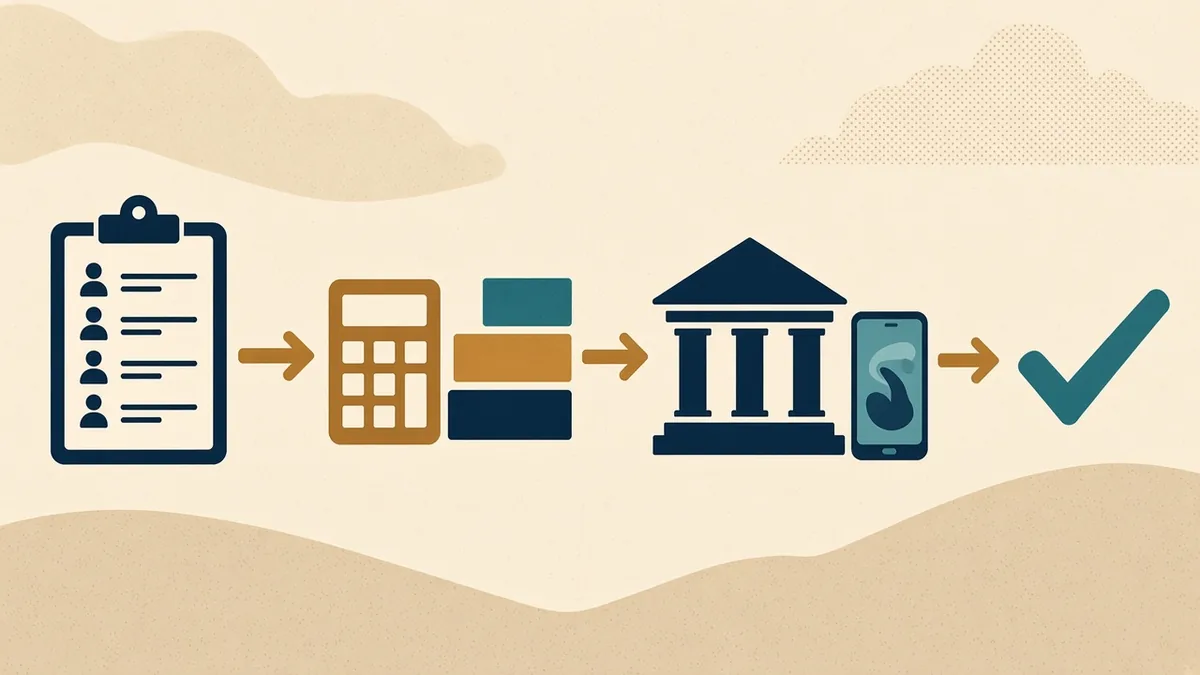
Every payroll system, whether a spreadsheet or a product, should follow the same order:
- Gross pay. Basic salary plus taxable allowances, overtime and bonuses for the month.
- Employee SSNIT. Deduct 5.5% of basic salary, not of gross pay.
- Reliefs. Deduct any qualifying voluntary provident fund contribution, up to the limit GRA allows.
- Chargeable income. What is left. Apply the bands slice by slice, never one rate to the whole amount.
- Net pay. Gross pay minus SSNIT, voluntary pension, PAYE and any staff loan or advance repayments.
A quick illustration using the 2026 bands: a resident worker on a basic salary of GH₵5,000 with no allowances pays GH₵275 in SSNIT, leaving GH₵4,725 chargeable. PAYE is GH₵785.75, and take-home pay is GH₵3,939.25. The employer separately pays GH₵650 (13%) as its own pension cost. Use this only to test your own system; real payslips depend on allowances, reliefs and benefits.
If your software cannot show this calculation line by line for any employee, you cannot check it, and neither can an auditor.
What payroll software in Ghana must handle
A payroll tool built for another country, or a generic HR app with a “tax” field, usually breaks on Ghana-specific details. Check for these before you pay for anything:
- Current PAYE bands with effective dates. The tool should store bands by date, so a September change does not rewrite August.
- SSNIT on basic salary, with the insurable earnings limits. TaxLawGH’s PAYE guide lists the 2026 monthly range as GH₵587.80 to GH₵69,000.
- Tier 2 split and provider details. The 5% must go to the right trustee, with a schedule that matches.
- Resident and non-resident staff. Expatriates and short-term contractors are taxed differently.
- Allowances and benefits. Transport, rent, fuel and vehicle benefits, each flagged taxable or not.
- Loans and salary advances. Deducted automatically, with a running balance per employee.
- Payslips staff can read on a phone. Many workers never open email. A link by SMS or WhatsApp works better.
- Remittance schedules. The monthly PAYE return to GRA, due by the 15th of the following month, and the SSNIT contribution report and payment within 14 days of month end.
- Payment files. A bank bulk-payment file or a MoMo bulk disbursement list, so nobody retypes account numbers.
- Audit trail. Who changed a salary, when, and who approved the run.
Paying salaries by bank and MoMo
Many Ghana employers pay office staff by bank transfer and casual, site or field workers by mobile money. That split is where errors hide. Good payroll software produces one approved list per run and then splits it by payment method, rather than having one person build a bank file and another build a MoMo list from memory.
Two habits save most of the pain:
- Lock the run before paying. Once the run is approved, amounts cannot change without a new approval.
- Match payments back. After disbursement, mark each line paid from the bank or MoMo provider’s record, not from a screenshot. Our guide to reconciling MoMo payments with sales uses the same principle for money coming in.
Failed transfers, wrong wallet names and staff who changed numbers should land in an exceptions list that someone clears before the next run.
Ready-made payroll tool or custom payroll module?

Several Ghana payroll and HR products already handle PAYE and SSNIT, and for many firms one of them is the right answer. The question is whether payroll stands alone or depends on data from the rest of your operation.
| Question | Favour a ready-made payroll tool | Favour a custom payroll module |
|---|---|---|
| Where do hours and allowances come from? | Fixed monthly salaries entered by HR | Shift logs, site attendance, trips or piece rates from your own systems |
| How many pay rules do you have? | One or two salary structures | Many grades, sites, union rules or project-based pay |
| Who gets paid? | Mostly permanent office staff | A large share of casual, field or seasonal workers |
| What else must it feed? | A monthly journal into accounting | Job costing, project budgets, branch profit reports |
| Budget shape | Monthly subscription per employee | A build plus care, worth it when payroll errors or rework are costly |
A logistics firm paying drivers per trip, a farm paying seasonal workers by the day, or a security company paying guards by shift and site often find that the hard part of payroll is not the tax. It is collecting accurate hours and allowances from the field. That is where a payroll module inside your own operations software earns its cost, because attendance, dispatch and payroll share one record instead of three spreadsheets.
If you are weighing the two routes, our guide to custom software vs ready-made tools in Ghana walks through the trade-offs, and custom software development cost in Ghana explains what drives the budget. At PED Solution Studios, custom software is scoped per project after a call, so the price follows what version one must do on day one.
Payslips and staff self-service

Payslip questions eat HR time. “Why is my pay lower this month?” usually has a simple answer: a loan deduction, fewer shifts, or a new tax band. A payslip that shows each deduction and a short note on changes answers most of those questions before they reach the office.
Useful self-service features, in order of value:
- Payslip history on the phone, protected by a PIN or one-time code.
- Loan and advance balances.
- Leave balances, if leave affects pay.
- A simple form to report a wrong payslip, which goes to a named person.
Salary data is personal data under Ghana’s Data Protection Act, 2012 (Act 843), so limit who can see pay records, and remove access when staff leave.
A checklist before your next payroll run
- Confirm the bands. Run the worked example above through your system and compare.
- Check SSNIT is on basic salary, and that the minimum and maximum insurable earnings apply.
- List every allowance and mark it taxable or not, with a reason.
- Separate approval from payment. The person who approves the run should not be the only person who sends the money.
- Keep remittance dates on a calendar. PAYE by the 15th, SSNIT within 14 days.
- Reconcile the bank and MoMo payouts against the approved run.
- Export a monthly journal for your accountant, so payroll and the books agree.
Frequently asked questions
What is the best payroll software in Ghana?
The best tool is the one that uses the current GRA bands, calculates SSNIT and Tier 2 correctly, and fits how your staff are paid. A firm with fixed salaries can use a ready-made product. A firm paying by shift, trip or site often needs payroll linked to its own operations data.
Did PAYE change in Ghana in 2026?
Yes. GRA published new resident PAYE bands effective 1 September 2026. The first GH₵588 of monthly chargeable income is taxed at 0%, rising in slices to 35% above GH₵50,000. Check the GRA PAYE page for the official table before you update any system.
How much SSNIT does an employer pay in Ghana?
The employer pays 13% of basic salary and deducts 5.5% from the worker, a total of 18.5%. Of that, 13.5% goes to SSNIT and 5% to the worker’s Tier 2 scheme. Contributions are due within 14 days after the end of the month.
Can payroll software pay staff by MoMo?
Many tools can export a bulk payment file for a bank or a mobile money provider. The safer setup locks the approved run first, then marks each payment as paid from the provider’s record, with failed payments listed for follow-up.
Should I build my own payroll system?
Only if payroll depends on data you already hold elsewhere, such as shifts, trips or site attendance, or if errors and manual work are costly. For simple monthly salaries, a ready-made product is usually cheaper and faster to set up.
Can PED add payroll to our existing system?
Yes, if payroll belongs inside your operations software. We scope it with you first, including how hours, allowances and payments flow. Book a call and bring an anonymised payroll sheet; that is the brief.
Fix the bands first, then fix the process
The September 2026 band change is a good reason to check your payroll properly: confirm the tax table, confirm SSNIT is on basic salary, and make sure approval, payment and reconciliation are separate steps. If your payroll pain is really about collecting hours and allowances from the field, book a call and we will map it with you before anything is built.